
Where it comes from. What you can do about it.
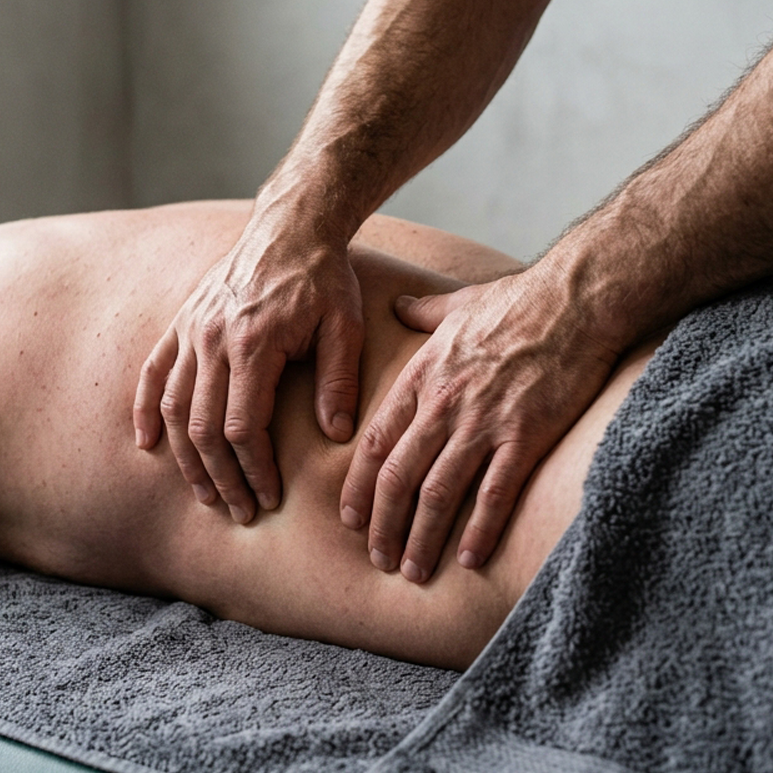
A back that's stuck after a day of sitting. A neck that won't cooperate in the morning. A shoulder that has been nagging for weeks and that you've started moving around without noticing. Usually something like that passes by itself. Sometimes it doesn't.
Your neck holds your head in place all day. If you sit with your head slightly forward, over a laptop or a phone, or behind a steering wheel, that weight gets heavier to carry. The muscles between your neck and your shoulder blades are then lightly switched on for hours on end. Not heavily, but without a break.
Your shoulder blade lies loose against your rib cage and glides over it. The only bony connection to your trunk runs through your collarbone; otherwise muscles hold it in place. If you work a lot with your arms in front of you, that pulls your shoulder blades forward, and the muscles between them work against that all day. That's often the spot people point to when they say their neck is stuck.
What you feel is often not where it starts. Neck pain regularly comes from the upper back and the shoulders. A headache around your temples can come from the muscles under the edge of your skull.
With the lower back it's rarely one muscle. It usually comes in two ways: gradually, after weeks of a lot of sitting or standing in the same posture, or suddenly, after something your body wasn't used to. Moving house, a day of DIY, a garden that finally got its turn.
With the gradual kind there's often no identifiable cause. That sounds unsatisfying, but it usually means nothing is broken. Just a back that did the same thing for too long.
What makes it last longer is compensation. If something hurts, you start moving around it without noticing. Other muscles take over and start nagging in turn, sometimes in a place that seems to have nothing to do with the original complaint.
That's why we rarely treat only the spot that hurts. Which muscles are involved in your case, you can look up in the Body Guide.
In our practice in Nijmegen we start with a short intake. What do you do in a day? How long has it been going on? What makes it worse? What helps? That determines where we get to work.
Then we feel. Where is the tension, where does it continue, which muscle responds when we press somewhere else. We work with deep techniques on the spot itself and on the muscles around it that have taken over the work. What happens in such a muscle and why pressure does something about it is explained in What Massage Does.
Pain you feel somewhere other than where it comes from can come from a trigger point. A tense spot in your shoulder can cause pain down into your upper arm, a muscle in your buttock down into your thigh. What that is and how we work with it, you can read under Trigger Point Therapy. If the pain runs down into your fingers or toes, or if tingling or loss of strength comes with it, we don't treat until your GP has looked at it.
The area can be sensitive for a day or so afterwards. In Aftercare you can read what's best to do then.
How many sessions you need depends on the situation. Usually we suggest one more session after the first, sometimes we work towards three. After that we don't push. We are massage therapists, not physiotherapists.
Massage doesn't change what your day looks like. If you keep sitting in the same posture for eight hours, the tension comes back. What we can do: take the tension off and let you notice which muscles are involved. The rest happens outside the practice.
For some complaints we mention a few exercises. One or two, three at most, and without a schedule. Most people don't really get going with them at home, and we know that. We mention them anyway, because then you know what's in your own hands.
We don't diagnose. Call your GP first if the pain runs down into your fingers or toes, if tingling, numbness or loss of strength comes with it, or if the pain gets worse at night.
Are you in doubt, being treated elsewhere, taking blood thinners, do you have osteoporosis, or have you recently had an accident or surgery? Then check with your GP first. We also ask about this at the intake.
If something comes out of that, we don't treat. We don't want you to keep coming to us while something else is going on.
If it's your first time, a Customized Massage of 45 or 60 minutes is usually the right way in. If it has been going on longer and keeps coming back, a Trigger Point Program makes more sense: the sessions build on each other. What the treatments cost is listed under Prices.
What clients write about us is under Reviews.
Questions? Get in touch. Derek +31 6 41 61 01 29, Dawid +31 6 46 00 35 66, info@manibus.nl.
Gerard Noodtstraat 119 - 2 in Nijmegen.


